


Prince (August 23, 1990) – “‘Graffiti’ puts Prince back on track” Feature – Austin American‑Statesman

This Austin American‑Statesman feature by Michael MacCambridge reviews Graffiti Bridge, describing Prince’s renewed creative energy and calling the project a “full‑blown call to funk‑rock arms.” The article positions the soundtrack and film as a confident return to form after Batman, reaffirming his genius and musical range.

Publication: Austin American‑Statesman Date: August 23 1990 Country: United States
The review highlights Graffiti Bridge as Prince’s latest double‑album and film project, featuring contributions from The Time, George Clinton, Mavis Staples, and Tevin Campbell. MacCambridge praises the album’s 17‑song suite for its spiritual depth and funk‑driven vitality, noting standout tracks such as Release It, Love Machine.
The critic contrasts the new work with the darker Batman soundtrack, describing Graffiti Bridge as a reaffirmation of Prince’s creative brilliance and his ability to merge faith, funk, and flamboyance.
CONTEXT AND NOTES
By 1990, Prince was re‑establishing his independence through Paisley Park.
Graffiti Bridge bridged his 1980s legacy with a new spiritual direction, marking a turning point in his late‑career resurgence.
The review’s tone reflects renewed critical respect, positioning the project as a comeback and a celebration of his artistry.
FEATURE HIGHLIGHTS
Event: Prince’s return to the spotlight with Graffiti Bridge
Era: 1990 – Graffiti Bridge
Tone: Analytical, celebratory, and reverent
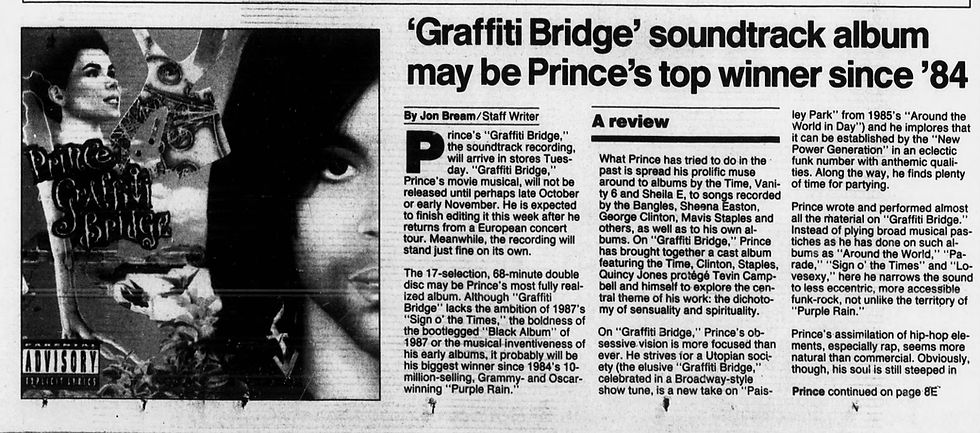
Photography: Promotional artwork and film stills from Graffiti Bridge
WHAT THE CLIPPING SHOWS
Newspaper review headlined “‘Graffiti’ puts Prince back on track”
Commentary on Prince’s creative rebirth and musical range
Mentions of collaborators including The Time, George Clinton, and Mavis Staples
Three‑star rating for Graffiti Bridge across all formats
All magazine scans, photographs, and original text excerpts referenced in this entry remain the property of their respective copyright holders. This Chronicle entry is a transformative, non‑commercial archival summary created for historical documentation and educational reference. No ownership of the original material is claimed or implied.


Comments