


Prince (August 20/21, 1990) Graffiti Bridge - Album Release UK/US

Updated: Aug 22

Graffiti Bridge is Prince’s twelfth full‑length studio album and serves as the companion to the motion picture of the same name. Released worldwide in August 1990, (20 August 1990 (UK)
21 August 1990 (USA), it arrived fourteen months after Batman. Although it shares its name with an earlier abandoned film and soundtrack project from 1987/1988, the released album bears little resemblance to that earlier configuration, aside from the inclusion of “Graffiti Bridge,” “The Question Of U,” and “Melody Cool.”

For the first time, Prince incorporated songs he had written and produced for other artists into one of his own albums, with those tracks also appearing in the film. Many of the songs were revived from earlier vault recordings and reworked, giving the album the feel of a retrospective collection of previously unreleased material.
After the initial 1987/1988 version of Graffiti Bridge was shelved, Prince later revived the title for a substantially different film and album.
Multiple configurations of the 1990 album were assembled throughout late 1989 and 1990. The earlier 25 September 1988 configuration belongs to the first incarnation of the project and is treated separately.

Although several musicians are credited, most appear only briefly, with Prince performing the majority of the work himself. The album draws from recordings spanning the entire 1980s.
“Tick, Tick, Bang” began in 1981 before being re‑recorded in 1989. “Can’t Stop This Feeling I Got” was first tracked in 1982, revisited in 1986, and completed in 1989. “We Can Funk” originated on New Year’s Eve 1983 as “We Can Fuck,” was reworked in 1986, and the album version—based on the 1983 recording—was completed in 1989.
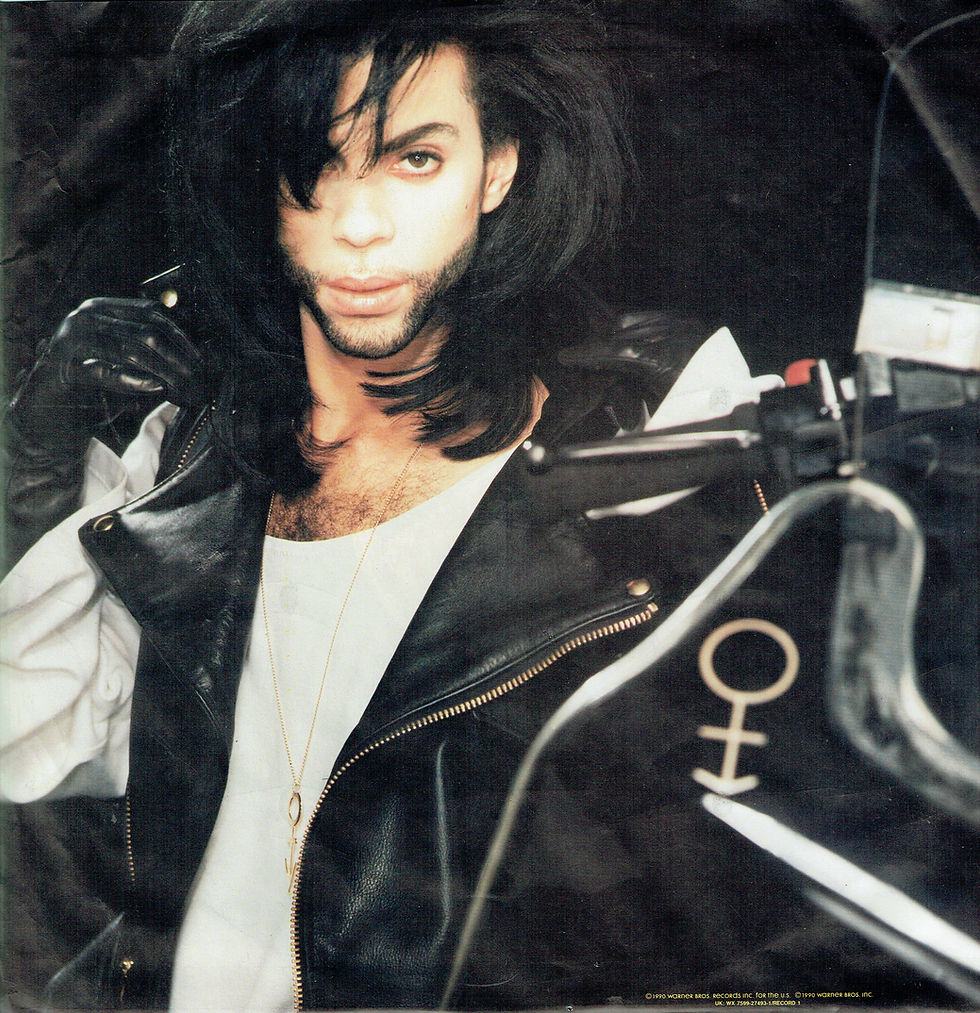
“The Question Of U” was recorded in 1985 with additional work in 1987. “Joy In Repetition” dates from 1986. “The Latest Fashion” was first recorded in 1987. “Graffiti Bridge” and “Melody Cool” were recorded in 1987, with Mavis Staples’ vocals added to “Melody Cool” in late 1989.
“Still Would Stand All Time” and “Elephants & Flowers” were recorded in October 1988 and were once intended for Rave Unto The Joy Fantastic. “Release It,” “Love Machine,” and “Shake!” were recorded in 1989 for The Time’s Corporate World, along with a reworking of “The Latest Fashion,” but were moved to Graffiti Bridge when Pandemonium replaced Corporate World.
“Round And Round” was recorded in late 1989, around the same time “New Power Generation” was reworked from “Bold Generation.” The final recording for the album, “Thieves In The Temple,” took place in February 1990.
Prince did not tour to support the album, though he was nearing the end of the Nude Tour at the time of release, he had included "The Question Of U" during most of the shows.
Track Listing LP

Side 1
• Can’t Stop This Feeling I Got — Prince — 4:24
• New Power Generation — Prince — 3:39
• Release It — Prince, Levi Seacer Jr. — 3:54
• The Question Of U — Prince — 4:00
Side 2
• Elephants & Flowers — Prince — 3:54
• Round And Round — Prince — 3:55
• We Can Funk — George Clinton, Prince — 5:28
• Joy In Repetition — Prince — 4:53
Side 3

• Love Machine — Prince, Levi Seacer Jr., Morris Day — 3:34
• Tick, Tick, Bang — Prince — 3:30
• Shake! — Prince, Morris Day — 4:01
• Thieves In The Temple — Prince — 3:20
Side 4
• The Latest Fashion — Prince, The Time — 4:02
• Melody Cool — Prince — 3:39
• Still Would Stand All Time — Prince — 5:23
• Graffiti Bridge — Prince — 3:51
• New Power Generation (Pt. II) — Prince — 2:57
Total length: 68:34

CD Variant (Full Track Listing)
• Can’t Stop This Feeling I Got — 4:24
• New Power Generation — 3:39
• Release It — 3:54
• The Question Of U — 4:00
• Elephants & Flowers — 3:54
• Round And Round — 3:55
• We Can Funk — 5:28
• Joy In Repetition — 4:53
• Love Machine — 3:34
• Tick, Tick, Bang — 3:30 • Shake! — 4:01
• Thieves In The Temple — 3:20
• The Latest Fashion — 4:02
• Melody Cool — 3:39
• Still Would Stand All Time — 5:23
• Graffiti Bridge — 3:51
• New Power Generation (Pt. II) — 2:57

Production
Prince — producer and arranger
Levi Seacer Jr. — co‑producer; co‑arranger
Clare Fischer — orchestral arrangements
Junior Vasquez — remix
David Z. — mix
Keith “K.C.” Cohen — mix
Susan Rogers — engineer; mix
Femi Jiya — engineer
Michael Koppelman — engineer
Dave Friedlander — engineer
Tom Garneau — engineer
Eddie Garcia — engineer
Mark Plati — engineer; programming
Larry Ferguson — engineer
Coke Johnson — assistant engineer
Howie Weinberg — mastering
Michael Koppelman — mastering
Steve Parke — cover illustration
Tom Recchion — art direction
Margo Chase — logos
Bob McNamara — portraits
US LONGBOX CD EDITION FRONT
Personnel (Full Track‑Specific Credits)
Prince — all vocals and instruments except where noted
Morris Day — drums; lead vocals; background vocals
Levi Seacer Jr. — bass; distortion samples; backing vocals
Rosie Gaines — background vocals
New Power Generation — background chant
Jerome Benton — background vocals; crowd noise
Candy Dulfer — saxophone
David Garibaldi — drums (sampled)
Tevin Campbell — lead vocals
Eric Leeds — saxophone
Atlanta Bliss — trumpet
Wendy Melvoin — guitar; background vocals
Lisa Coleman — keyboards; background vocals
Joseph “Amp” Fiddler — keyboards; background vocals
George Clinton — co‑lead vocals
Garry Shider — background vocals
Steve Boyd — background vocals
William Payne — background vocals
Belita Woods — background vocals
Tracey Lewis — background vocals
Mike Harris — background vocals
Pat Lewis — background vocals
Sandra Dance — background vocals
Elisa Fiorillo — vocals
Mitch Mitchell — drums (sampled)
Jana Anderson — background voice
Lester Chambers — harmonica (sampled)
Robin Power — crowd noise; background voice
Tom Garneau — crowd noise
Michael Koppelman — crowd noise
Mavis Staples — lead vocals
Jevetta Steele — background vocals
Fred Steele — background vocals
JD Steele — background vocals
Jearlyn Steele — background vocals
Jill Jones — background vocals
Jellybean Johnson — background vocals
Jesse Johnson — background vocals
Jimmy Jam — background vocals
Monte Moir — background vocals
Terry Lewis — background vocals
Boni Boyer — organ; background vocals
Sheila E. — drums; background vocals
T.C. Ellis — rap
Album Details
Released: 20 August 1990 (UK); 21 August 1990 (USA)
Recorded: Various sessions 1981–1990
Studios: Paisley Park; Sunset Sound; Electric Lady; United Sound; others
Length: 68:34
Producer: Prince
Charts
UK Albums Chart
Peak Position: 1 (1 week)
Date: 1 September 1990
USA: Billboard Top Pop Albums
Peak Position: 6
Entry Date: 22 September 1990
Weeks in Chart: 24
USA: Billboard Top Black Albums
Peak Position: 6
Entry Date: 13 October 1990
Weeks in Chart: 21
In-store display 12 x 12 front and back
Reception
Upon its August 1990 release, Graffiti Bridge drew a wave of critical attention that measured Prince’s latest work against the towering legacy of Purple Rain. Reviews from major U.S. outlets praised its ambition, collaborative energy, and spiritual depth, while noting its narrower, funk‑rock focus compared to his earlier, more experimental albums.
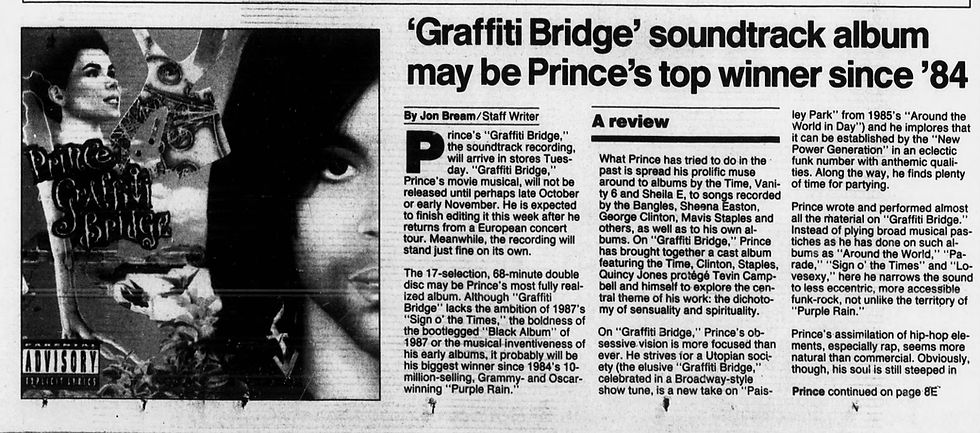
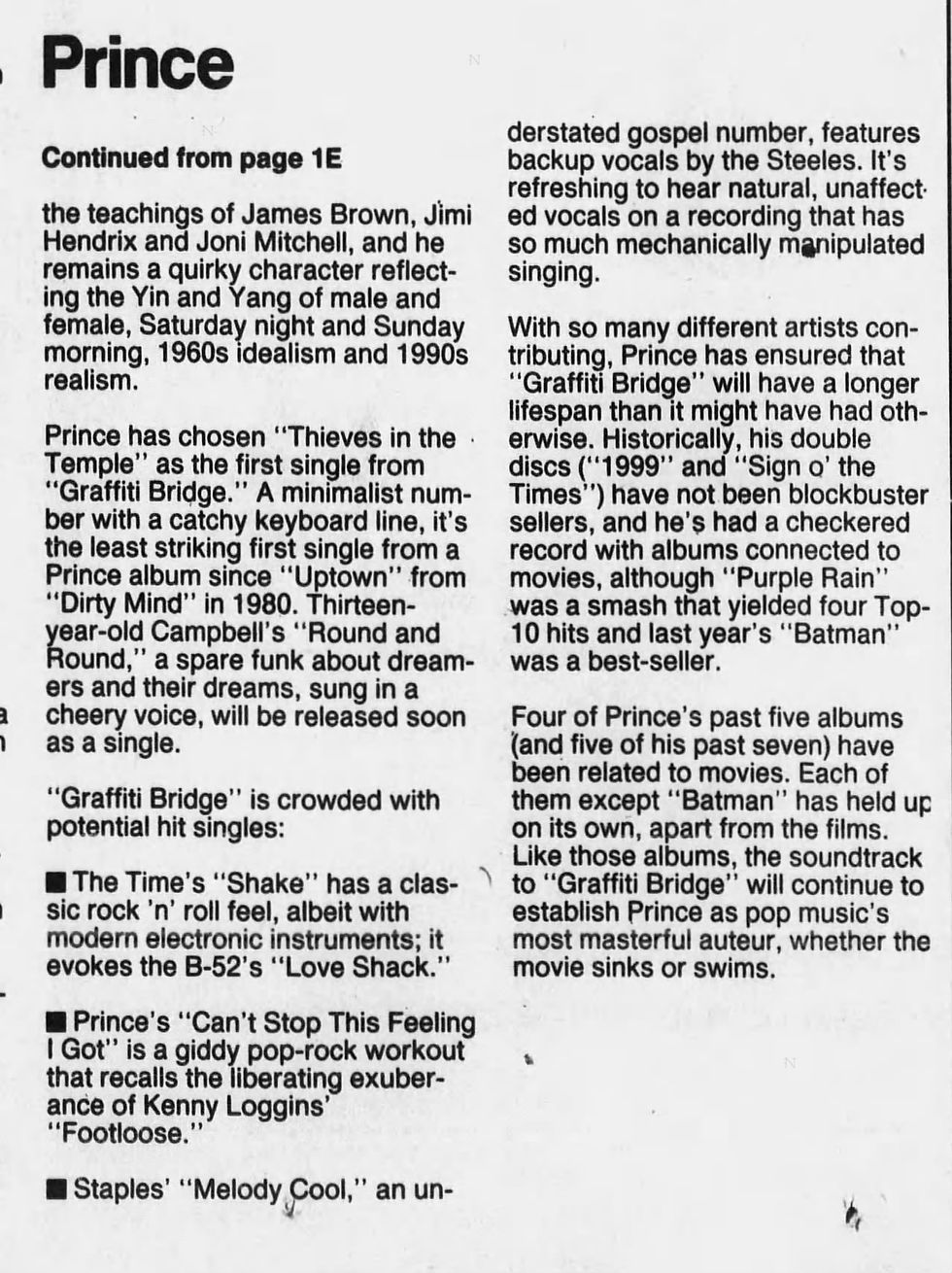
Critics described Graffiti Bridge as Prince’s most fully realized project since 1984, a 17‑track double album that balanced sensuality and faith. Jon Pareles (Huntsville News) highlighted its “balance of sensual and spiritual impulses,” while Jon Bream (Star Tribune) called it “Prince’s top winner since ’84,” commending its accessible funk‑rock sound and the strength of its collaborations with The Time, Mavis Staples, Tevin Campbell, and George Clinton. The album’s lead single, Thieves in the Temple, was singled out for its minimalist keyboard line and haunting tone, marking Prince’s most striking single since Uptown (1980). Other tracks such as Round and Round, Shake, and Melody Cool were praised for their variety and vitality, ensuring the soundtrack’s longevity beyond the film itself. While some reviewers noted that Graffiti Bridge lacked the cinematic cohesion of Purple Rain, most agreed that it reaffirmed Prince’s mastery as a pop auteur — a musician capable of blending funk, gospel, and hip‑hop into a unified vision of redemption and desire.
Five singles were released

A. Thieves In The Temple (3:20)
B. Thieves In The Temple (Part II) (1:41)
17 July 1990 (7" release)
2 August 1990 (US maxi-single release)
Cat #: US: 7-19751
UK: W9751
DE: 5439-19751-7
AU: MX305875-6

A. New Power Generation (3:39)
B. New Power Generation Part II (2:57)
Cat #: US: 7-19525
UK: W9525
DE: 5439-19525-7
AU: MX306045-6
22 October 1990 (UK 7" release)
23 October 1990 (US 7" release)
29 November 1990 (US maxi-single release)
25 March 1991 (Japan CD)

“Round And Round” (Tevin Campbell)
A. Round And Round (Album Version) (3:55)
B. Round And Round (Soul Dub) (5:02)
Cat #: USA: 7-19748
UK: W 0023
EUR: 5439-19748-7
Released: 25 September 1990
Round And Round (Soul Dub) (5:02)
Round And Round (Soul Mix Edit) (4:54)
Round And Round (Soul Mix Extended) (6:39)
Round And Round (The House) (7:30)

“Melody Cool” (Mavis Staples),
A. Melody Cool (Edit) (3:16)
B. Time Waits For No One (Edit) (4:18)
Cat #: UK: W9728
GER: 5439-19728-7
Released:
10 August 1990 (NET)
4 December 1990 (USA)
Melody Cool (Deep House Vocal) (6:22)
Melody Cool (Edit) (3:16)
Melody Cool (Extended LP Mix) (4:42)
Melody Cool (Extended Remix) (6:05)
Melody Cool (Mellow Dub Mix) (4:33)

“Shake!” (The Time).
12" 5" CD
A1. Shake! (Extended Mix) (4:57)
A2. Shake! (Battle Mix) (4:01)
A3. Shake! (Funky House Mix) (8:03)
B1. The Latest Fashion (Remix) (6:15)
B2. Shake! (Boom Mix) (5:05)
B3. Shake! (Album Version) (4:01)
Released: 8 January 1991
"Can't Stop This Feeling I Got" was released as a 7" double A-side in the Philippines (WB-77-708).
A. Can’t Stop This Feeling I Got (4:24)
B. Can’t Stop This Feeling I Got (4:24)
Cat #: PHL: WB-77-708
“Tick, Tick, Bang” and “The Question Of U” were also considered as singles, with “The Question Of U” initially planned as the lead single until “Thieves In The Temple” was recorded.
In the US, "The Latest Fashion" was also issued as a 12" test pressing (Pro-4558).

Notes – Allen Beaulieu and Prince at Graffiti Bridge (Eden Prairie Shoot)
Allen Beaulieu, Prince’s longtime photographer and visual collaborator, brought him to the Graffiti Bridge site in suburban Eden Prairie, Minnesota for a photo session at the famous graffiti wall.
Beaulieu had worked with Prince since the late 1970s, shaping his early visual identity through album covers, promotional portraits, and tour photography. His lens helped define the aesthetic of Prince’s rise from local talent to international star.
During the shoot, Prince spray‑painted his own name onto the wall, adding to the collage of messages already there.
The session was brief — only one roll of film was shot before a crowd gathered, eager to catch a glimpse of the rising superstar.
The resulting image shows Prince in a light trench coat with a red shirt, standing against the graffiti‑covered wall marked with “PRINCE” in bold red letters.

This photograph became emblematic of Prince’s connection to his Minneapolis roots and the visual mythology that later inspired the Graffiti Bridge film and album.
Beaulieu’s work at this location captured the intersection of urban art, music, and local legend, preserving a moment that symbolized Prince’s transformation from hometown prodigy to cultural icon.
SOURCES Discogs, 45 World, Wikipedia, BBC Official Charts, Prince Vault, Sleeveographia2, Star Tribune Minneapolis, Minnesota · Monday, August 20, 1990,Daily News New York, New York · Monday, August 20, 1990.
All magazine scans, photographs, and original text excerpts referenced in this entry remain the property of their respective copyright holders. This Chronicle entry is a transformative, non‑commercial archival summary created for historical documentation and educational reference. No ownership of the original material is claimed or implied.


Comments