


Prince (October 22, 1987) – “Prince’s Ex-Mates Seek Own Identity” Feature - The Brainerd Daily Dispatch

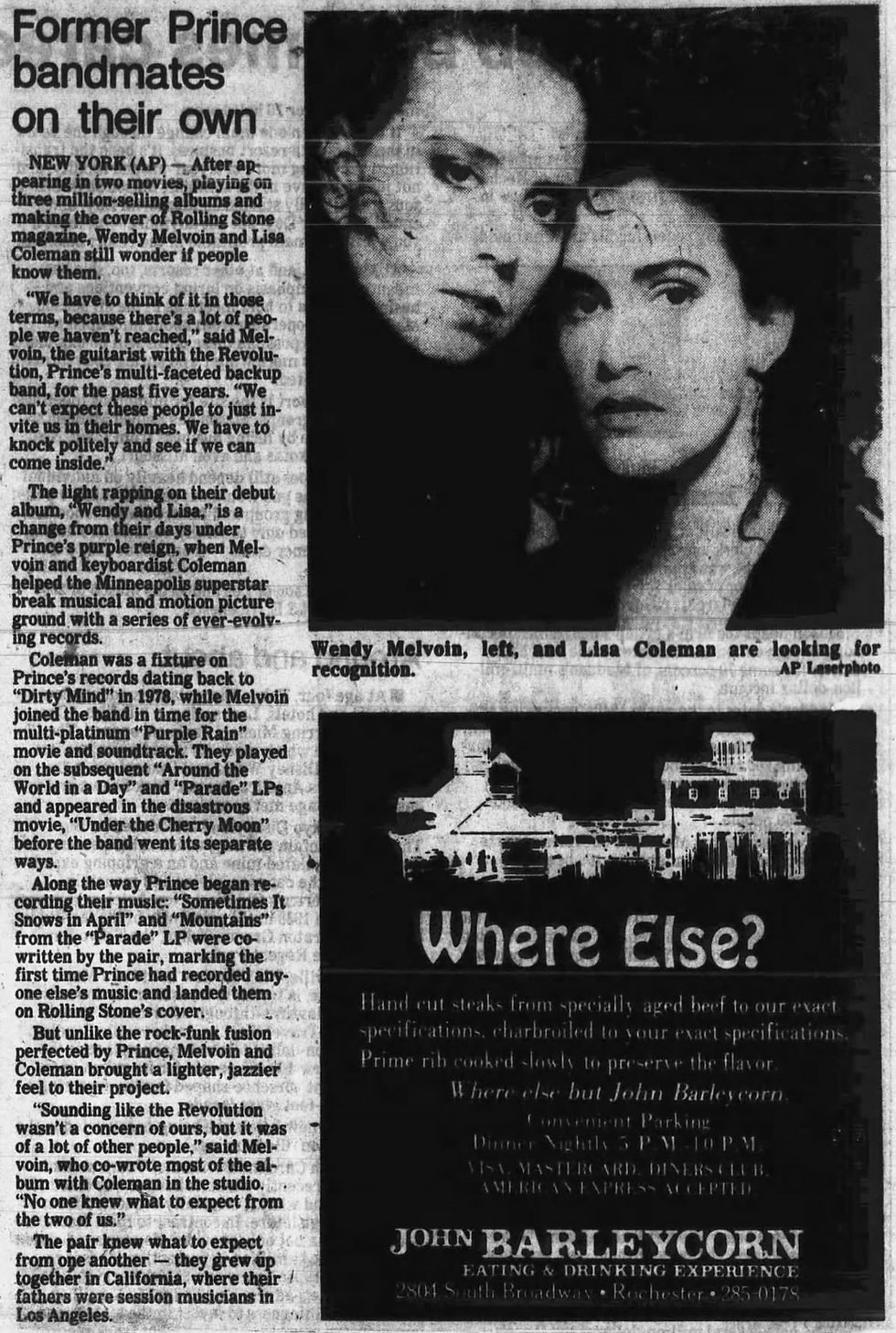
This substantial Brainerd Daily Dispatch feature focuses on Wendy Melvoin and Lisa Coleman as they establish a musical identity beyond their years working with Prince and The Revolution. Written by Larry McShane, the article looks back at their contributions to Prince’s records and films while examining the creation of their debut album Wendy and Lisa, the ending of The Revolution and their determination to be recognised on their own terms.

Publication: The Brainerd Daily Dispatch
Date: October 22, 1987
Country: United States
Published under the headline “Prince’s ex-mates seek own identity”, Larry McShane’s Associated Press feature begins by acknowledging the considerable visibility Wendy Melvoin and Lisa Coleman had already achieved through their association with Prince.
The article notes appearances in two movies, performances on three million-selling albums, and a Rolling Stone cover, yet explains that Melvoin and Coleman were still conscious that many listeners primarily knew them through Prince.
Melvoin describes the challenge of changing that perception, saying there remained many people they had yet to reach and that they needed to introduce themselves to those audiences in their own right.
The feature identifies their debut album, Wendy and Lisa, as an important break from the period spent working within Prince’s musical organisation. Coleman’s association with Prince’s recordings is traced back to Dirty Mind in 1978, while Melvoin is described as joining in time for the Purple Rain film and soundtrack.
Their subsequent work alongside Prince included Around The World In A Day and Parade, as well as an appearance in Under The Cherry Moon, before The Revolution went its separate ways.
The article also highlights their creative contribution to Prince’s recordings. “Sometimes It Snows In April” and “Mountains” from Parade are identified as songs co-written by Prince, Melvoin and Coleman. McShane describes this as the first time Prince had recorded someone else’s music and placed it on a release carrying the Rolling Stone cover star’s name.
THE REVOLUTION AND MOVING FORWARD
Melvoin explains that although their association with The Revolution mattered to them, their own musical approach was not simply an attempt to recreate the band's sound.
The article describes Melvoin and Coleman as long-time friends who had known one another since childhood. After the ending of The Revolution, they entered the studio within two weeks and began work on their own album without initially having a record contract.
Coleman explains that self-financing the sessions gave them the freedom to enter the studio and begin the project themselves.
Former Revolution drummer Bobby Z joined them as co-producer. Melvoin and Coleman themselves played a wide range of instruments on the recording, from synthesisers through to drums.
The feature identifies “Waterfall” as the first single, describing Melvoin singing over a prominent guitar line. Another track, “White”, is described as a jazz-fusion instrumental closing the first side of the album.
According to Melvoin, once the project was completed there was little room left for lyrics because the record had developed primarily from feeling and atmosphere rather than a predetermined formula.
Much of the album is described as being concerned with relationships. Melvoin jokes that relationships were something the pair understood considerably better than nuclear physics.
PRINCE CONNECTION
The article does not present Wendy and Lisa’s departure as an attempt to reject their past with Prince. Instead, their years with Prince are described as formative experiences that they expected to remember fondly.
Their period working with Prince is compared to college years, with Melvoin referencing Zen and the Art of Motorcycle Maintenance while explaining that they were now attempting to find their own place and assemble the different elements of what they had learned.
The concluding comments carry a playful connection back to their former band. Once they had gathered enough experience and material, Melvoin jokes, they could “make the Revolution better” and get everyone back together to “blow the world up.”
CONTEXT AND NOTES
Published in 1987, the feature captures Wendy Melvoin and Lisa Coleman during the establishment of their post-Revolution career while preserving considerable contemporary detail about their work with Prince.
For a Prince Chronicle, the article is particularly useful because it documents the transition from The Revolution from the perspective of two musicians who had played central roles in Prince’s mid-1980s recordings and films.
The large accompanying photograph is captioned “WENDY MELVOIN and LISA COLEMAN – They wonder if people know them.”
FEATURE HIGHLIGHTS
Event: Wendy Melvoin and Lisa Coleman discuss establishing their own musical identity
Era: 1987 post-Revolution period
Tone: Reflective, independent and career-focused
Photography: Large black-and-white promotional photograph accompanying the feature
WHAT THE CLIPPING SHOWS
• Wendy Melvoin and Lisa Coleman discussing life and music after The Revolution
• References to Dirty Mind, Purple Rain, Around The World In A Day and Parade
• “Sometimes It Snows In April” and “Mountains” identified as collaborative compositions
• Discussion of the ending of The Revolution and the rapid start of the Wendy and Lisa album sessions
• Bobby Z joining the project as co-producer
• Discussion of “Waterfall” and the instrumental “White”
• Melvoin and Coleman describing their years with Prince as their formative “college years”
All magazine scans, photographs, and original text excerpts referenced in this entry remain the property of their respective copyright holders. This Chronicle entry is a transformative, non-commercial archival summary created for historical documentation and educational reference. No ownership of the original material is claimed or implied.

Comments