


Prince (December 13, 1980) “Dirty Mind” – The Globe and Mail

A detailed album review in Canada’s The Globe and Mail by Paul McGrath praising Prince’s Dirty Mind for its bold new-sounding rhythm and blues on Side One, while noting the more standard funk on Side Two, with special mention of the track “Sister” and English rock influences.

Publication: The Globe and Mail Date: Saturday, December 13, 1980 Country: Canada
Section / Pages: Music / Record Reviews
Title: Dirty Mind / Prince
THE STORY The review contrasts Prince’s first two albums with Dirty Mind, highlighting the strong first side featuring tracks like “When You Were Mine,” “Do It All Night,” and “Gotta Broken Heart Again.” It describes Side Two as less disciplined but saved by Prince’s “inspired wailing,” particularly noting “Sister” and tip-offs to English rock influences in black recording studios. The review is signed by Paul McGrath.
CONTEXT AND NOTES
This Canadian review appeared during the Dirty Mind Tour and reflects growing international critical interest in Prince’s innovative, genre-blending sound. While acknowledging some unevenness on Side Two, it appreciates the album’s freshness and Prince’s artistic risks.
FEATURE HIGHLIGHTS
Event: Album review of Dirty Mind (Warner Bros. XBS 3478)
Era: Dirty Mind Tour (1980) Tone: Analytical and mostly positive, with nuanced criticism Photography: None (text review) Visual Motifs: Standard newspaper music review column layout
WHAT THE CLIPPING SHOWS
Early international (Canadian) critical take on Dirty Mind
Recognition of Prince’s new wave/R&B fusion and specific track commentary
Balanced view noting both strengths and minor weaknesses
RELATED MATERIAL
For other relevant posts, see the tags at the foot of the page.
All magazine scans, photographs and original text excerpts remain the property of their respective copyright holders. This entry is a transformative, non-commercial archival summary created for historical documentation and educational reference.

Dirty Mind is Prince’s third studio album, released in October 1980. A daring, raw, and sexually explicit masterpiece, it marked a bold artistic leap and established Prince as one of the most provocative and innovative artists of his generation.
RELEASE DETAILS
Artist: Prince
Label: Warner Bros. Records
Date: October 8, 1980
Catalogue: BSK 3478
Format: LP
Country: United States (international releases followed)


THE STORY
Dirty Mind is a short, explosive album that fully embraces funk, new wave, and rock influences. Recorded quickly at his home studio in Orono, Minnesota (credited as “Somewhere in Uptown”), the album features Prince playing nearly all instruments himself. The songs are direct, explicit, and full of attitude, tackling themes of sex, freedom, and rebellion with a punk-like energy.
CONTEXT & NOTES
Coming less than a year after his previous album, Dirty Mind shocked many with its explicit content and minimalist sound. Though it received mixed commercial response at the time, it is now regarded as one of Prince’s most important and influential records, laying the groundwork for his revolutionary 1980s output.
TRACK LIST
Side One
Dirty Mind (4:11)
When You Were Mine (3:44)
Do It All Night (3:42)
Gotta Broken Heart Again (2:13)
Side Two
Uptown (5:30)
Head (4:40)
Sister (1:33)
Partyup (4:24)
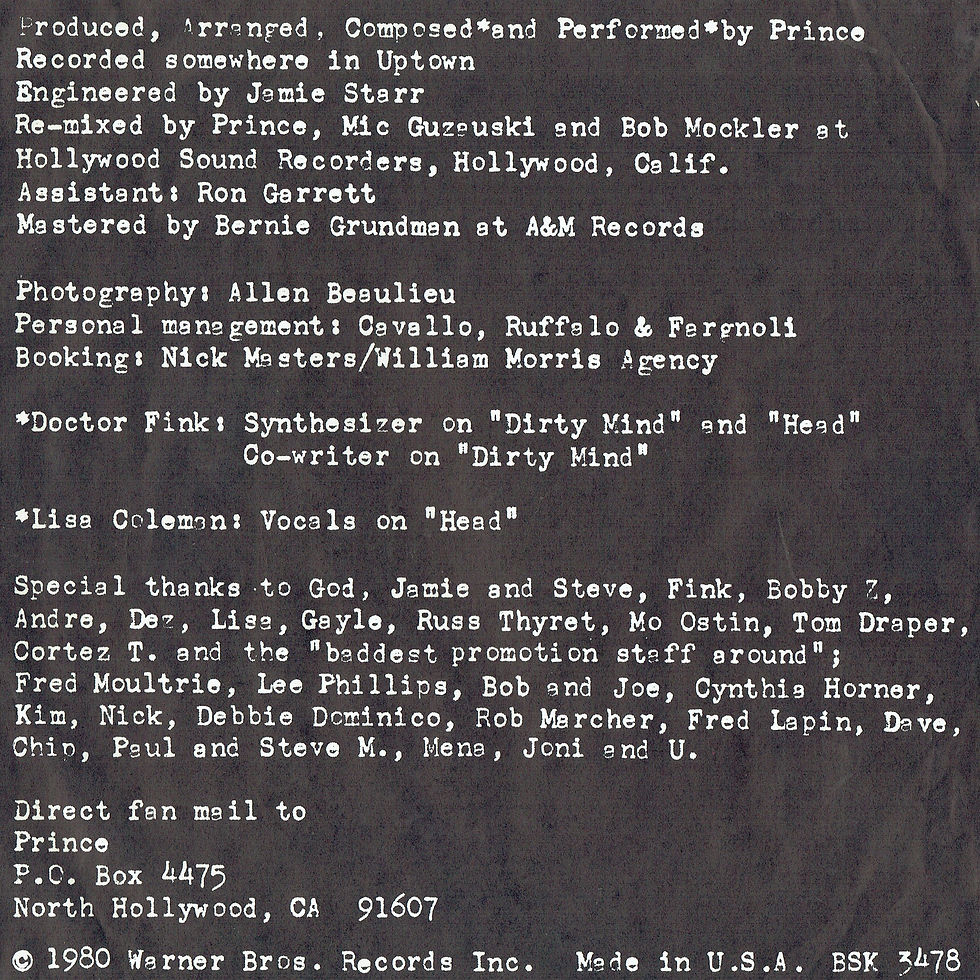
PERSONNEL
Musicians
Prince — all vocals and instruments (except where noted)
Dr. Fink — synthesizer on “Dirty Mind” and “Head”
Lisa Coleman — vocals on “Head”, keyboards and background vocals on “Partyup” (uncredited)
Production
Prince — producer, arranger, remixer
Jamie Starr — engineer (Prince pseudonym)
Mic Guzauski — remixer
Bob Mockler — remixer
Ron Garrett — assistant
Bernie Grundman — mastering (A&M Records)
Allen Beaulieu — photography
Bob Cavallo, Joe Ruffalo, Steve Fargnoli — personal management
Special Thanks "Special thanks to God, Jamie and Steve, Fink, Bobby Z., Andre, Dez, Lisa, Gayle, Russ Thyret, Mo Ostin, Tom Draper, Cortez T. and the 'baddest promotion staff around'; Fred Moultrie, Lee Phillips, Bob and Joe, Cynthia Horner, Kim, Nick, Debbie Dominico, Rob Marcher, Fred Lapin, Dave, Chip, Paul and Steve M., Mena, Joni and U."
PACKAGING HIGHLIGHTS
Iconic black-and-white cover photo of Prince in a trench coat and bandana
Minimalist design with bold pink lettering
Striking and controversial visual identity
WHAT THE SLEEVE SHOWS
The front cover shows a bare-chested Prince wearing an open trench coat, bandana, and dark underwear, staring directly at the camera with a provocative expression. The bold pink “Prince” logo dominates the top. The image perfectly captured the album’s raw, rebellious, and sexually charged attitude.
CHARTS America
Country: Chart | Entry Date | Peak Position | Weeks in Chart
USA: Billboard Top LP’s & Tapes | 8 Nov. 1980 | 45 | 31
USA: Billboard Soul LPs | 8 Nov. 1980 | 7 | 32
USA: The Billboard 200 | 14 May 2016 | 56 (R) | 2
SINGLES RELEASED
“Uptown” (b/w “Crazy You”)
“Dirty Mind” (b/w “When We’re Dancing Close and Slow”)
“Do It All Night” (UK only)
“Head” (promo only)
“When You Were Mine” (12" promo only)
Dirty Mind received widespread praise from critics. Simon Reynolds noted its rave reception, with rock writers hailing Prince as a genre-blending, gender-bending, and race-bridging savior of modern music. Barney Hoskyns called it “the glam-funk Let’s Get It On” in his New Musical Express review. Ken Tucker of Rolling Stone observed Prince’s shift from the romantic tone of his earlier albums to a liberating lewdness, mixing provocative wordplay with simple, catchy melodies over an electric sound. He praised Prince’s effortless delivery, blending Smokey Robinson’s sweetness with Richard Pryor’s raw humor, calling the record “cool music dealing with hot emotions” and, at its best, “positively filthy.” In The Village Voice, Robert Christgau compared the metallic textures and drum patterns to Funkadelic and the Rolling Stones, noting Prince’s falsetto linked him to the “love-man” tradition but with a bolder eroticism. Retrospective reviews, like Jim Green’s in The Trouser Press Guide to New Wave Records, also celebrated the album’s catchy tunes, witty lyrics, strong production, and Prince’s signature falsetto—provided the overt sexuality doesn’t turn listeners away.
SOURCES Prince Vault, The Beautiful Ones (2019), Discogs, Warner Bros. archives.
COPYRIGHT NOTICE All album artwork, photographs, logos, and original text excerpts remain the property of their respective copyright holders. This entry is a transformative, non-commercial archival summary created for historical documentation and educational reference.


Comments