


Prince (April 25, 1987) Billboard Magazine Cover + “Spotlight on the Twin Cities” Two-Page Feature

Updated: May 22
A landmark Billboard cover and major feature celebrating Prince and the explosive rise of the Minneapolis Sound as America’s newest musical wonderland.

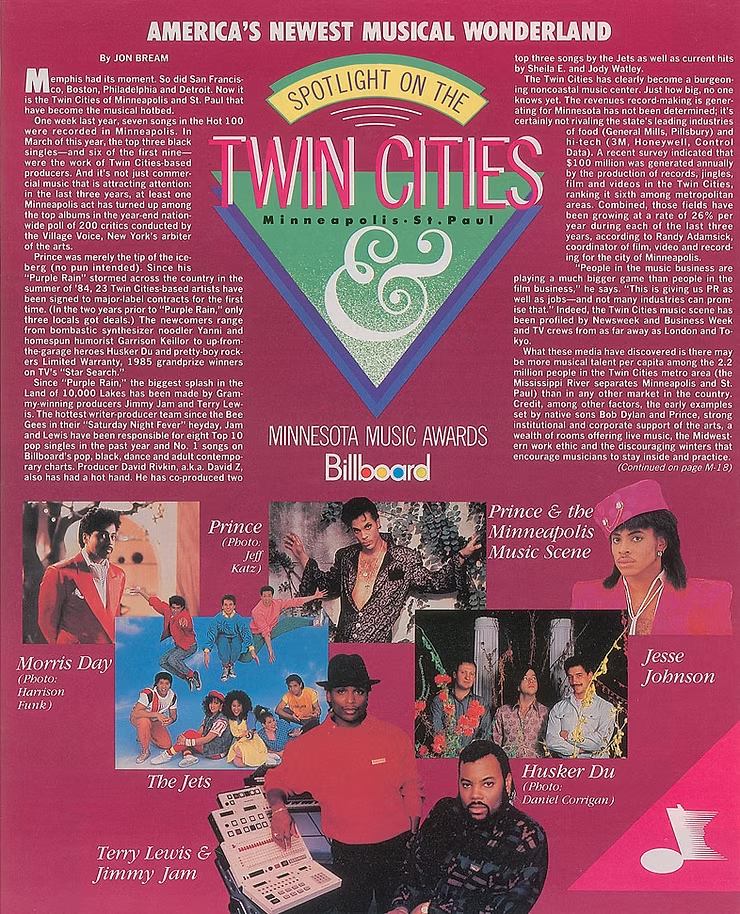
SOURCE DETAILS Publication: Billboard Date: April 25, 1987 Country: United States Section / Pages: Front Cover + Interior Feature (two-page spread)
THE STORY This iconic issue of Billboard shines a national spotlight on Prince and the vibrant Minneapolis–St. Paul music scene. The striking cover features a dramatic portrait of Prince, while the two-page interior spread, titled “America’s Newest Musical Wonderland,” explores how the Twin Cities became a creative powerhouse producing chart-topping hits and groundbreaking talent.
CONTEXT & NOTES By spring 1987, Prince had become a global superstar following the success of Purple Rain and Sign o’ the Times. This Billboard feature captures the moment when the “Minneapolis Sound” — a rich fusion of funk, rock, pop, and R&B — gained mainstream recognition. It highlights Prince as the central catalyst while showcasing a diverse ecosystem of artists including Jimmy Jam & Terry Lewis, Morris Day, Jesse Johnson, The Jets, and Hüsker Dü.
WHAT THE CLIPPING SHOWS A complete Billboard magazine issue: the front cover shows Prince in a dramatic, colour-saturated portrait with the headline “PRINCE and the Minneapolis Music Scene.” The two-page interior spread includes a large “Spotlight on the Twin Cities” graphic, in-depth text by Jon Bream, and a collage of photos featuring Prince, Morris Day, The Jets, Jesse Johnson, Hüsker Dü, and others. It vividly documents the city’s sudden emergence as a major force in American music.
RELATED MATERIAL For other relevant posts, see the tags at the foot of the page.
COPYRIGHT NOTICE All magazine artwork, photographs, logos, and original text excerpts remain the property of their respective copyright holders. This entry is a transformative, non-commercial archival summary created for historical documentation and educational reference.
Spotlight on the Twin Cities: When Minneapolis Became America’s New Musical Wonderland
In the mid‑1980s, something extraordinary was happening in Minneapolis–St. Paul. What had long been considered a quiet Midwestern region suddenly erupted into one of the most influential music hubs in the United States. The Billboard feature you see here — boldly titled “America’s Newest Musical Wonderland” — captures that moment of ignition, when the Twin Cities weren’t just producing hits; they were reshaping the sound of American pop, R&B, funk, and rock.
This wasn’t a scene built on hype. It was built on craft, community, and a fiercely independent creative spirit.
Prince: The Catalyst and the Conduit
At the centre of this musical supernova was Prince — not just as a chart‑topping artist, but as a gravitational force. His success didn’t simply elevate his own career; it pulled an entire city upward with him. The article frames him as the spark that lit the fuse, the artist whose vision and work ethic created a blueprint others could follow.
Prince didn’t just make hits.
He made infrastructure — studios, bands, protégés, and a sonic identity that became known worldwide as the Minneapolis Sound.
The Producers Who Rewrote the Rulebook
The feature highlights a remarkable statistic: in a single month, three Black singles produced in Minneapolis broke into the Billboard Hot 100 Top 10. That wasn’t a fluke. It was the result of a production culture that valued innovation over imitation.
Enter Jimmy Jam and Terry Lewis — alumni of The Time, protégés of Prince, and soon to become two of the most important producers in pop history. Their presence in the spread signals the moment they stepped out from behind the curtain and into the mainstream spotlight. Their work would soon dominate the charts, shaping the careers of Janet Jackson, Human League, and countless others.
A City of Scenes, Not Just Stars
What makes this page so compelling is the breadth of artists it showcases:
Morris Day, the charismatic frontman of The Time
Jesse Johnson, the guitar‑slinging architect of Minneapolis funk
The Jets, bringing polished pop to the masses
Hüsker Dü, proving the Twin Cities weren’t just about funk — they were a punk powerhouse too
This wasn’t a monoculture. It was a creative ecosystem, where R&B, funk, rock, pop, and punk thrived side by side.
Why Minneapolis?
The article hints at a deeper truth: Minneapolis succeeded because it wasn’t trying to be Los Angeles or New York. It had:
- affordable studio spaces
- a tight‑knit community
- a willingness to experiment
- musicians who played together, learned together, and pushed each other
It was a city where boundaries blurred — between genres, between races, between mainstream and underground.
A Moment That Became a Movement
Looking back, this Billboard feature reads like a snapshot taken just as the wave crested. Prince was already a superstar, but the full impact of the Minneapolis Sound was still unfolding. Jam & Lewis were only beginning their ascent. The Time, The Jets, and Hüsker Dü were all on the brink of national recognition.
The Twin Cities weren’t just producing hits.
They were producing culture.
And this page captures the moment the rest of America finally noticed.

Comments