
Elton John: "Goodbye Yellow Brick Road" Single (1973)
- Elton John

- Sep 20, 1973
- 5 min read
Updated: Sep 22, 2025
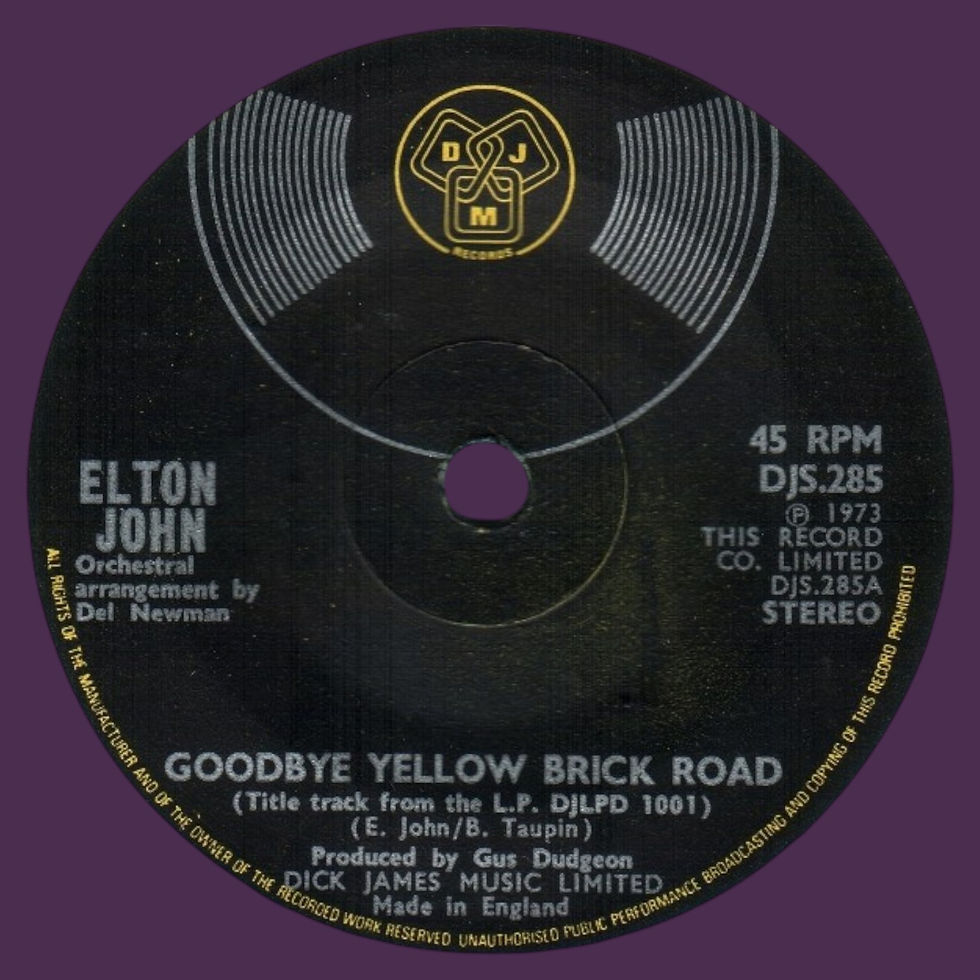
Elton John’s "Goodbye Yellow Brick Road" backed with "Screw You" (also known as "Young Man's Blues" in some regions), was released as a 7-inch vinyl single in the UK by DJM Records (catalog number DJS 285) on September 21, 1973. It was the second single from his iconic double album Goodbye Yellow Brick Road, widely regarded as one of his greatest works.
The Single:
"Goodbye Yellow Brick Road" / "Screw You"
Release Details
Released as a 7" vinyl, 45 RPM single on DJM Records (DJS 285) in the UK on September 21, 1973, and by MCA Records (MCA-40148) in the US.
The single was a major commercial success, reaching #1 in Canada, #2 on the US Billboard Hot 100, and #6 on the UK Singles Chart. It also charted globally, including #4 in Ireland, #7 in New Zealand, and #20 in Germany.
Certified Platinum in the US by the RIAA for sales exceeding 1 million copies, reflecting its widespread popularity.
A-Side:
"Goodbye Yellow Brick Road" (3:14):Written by Elton John (music) and Bernie Taupin (lyrics), this is a timeless ballad from the Goodbye Yellow Brick Road album, often cited as one of John’s signature songs.
The lyrics, penned by Taupin, reflect a longing for simplicity and a rejection of fame’s excesses, inspired by Taupin’s rural upbringing ("Back to the howling old owl in the woods / Hunting the horny back toad").
The title references The Wizard of Oz, symbolizing a desire to leave the glitzy, illusory path of stardom for authenticity.
Musically, it features John’s emotive piano and vocals, backed by a lush arrangement with Gus Dudgeon’s production, including strings and subtle percussion. The core band—Davey Johnstone (guitar), Dee Murray (bass), and Nigel Olsson (drums)—delivers a polished, melodic sound.
Recorded at Château d’Hérouville in France, the track showcases the peak of John’s 1970s songcraft, blending pop, rock, and orchestral elements.
Its universal appeal has made it a staple in John’s live performances and a frequent feature in pop culture, covered by artists like Billy Joel and Sara Bareilles.
B-Side:
"Screw You" (4:44, retitled "Young Man's Blues" in the US):
Also written by John and Taupin, "Screw You" is a rollicking, guitar-driven rock track from the Goodbye Yellow Brick Road album sessions, though it was not included on the final album tracklist in most regions.
The song’s raw energy, with gritty guitar riffs by Davey Johnstone and a driving rhythm section, contrasts the A-side’s introspection. Lyrics are playful yet rebellious, reflecting a young man’s defiance and zest for life.
In the US, the title was changed to "Young Man's Blues" to avoid radio censorship due to the phrase "screw you," which was deemed too provocative. The US B-side is identical in content, just retitled.
Produced by Gus Dudgeon, it features the same band as the A-side, with a looser, Faces-like rock vibe. While less iconic than "Goodbye Yellow Brick Road," it’s a fan favorite for its high-energy performance and rarity.
The track appears on some expanded reissues of Goodbye Yellow Brick Road (e.g., 2014 deluxe editions) and is available on streaming platforms as part of these collections.

Context and Background
Elton John in 1973:By 1973, Elton John was a global superstar, following hits like "Rocket Man" (1972), "Crocodile Rock" (1972), and Honky Château (1972). The Goodbye Yellow Brick Road album, a double LP, solidified his reputation as a versatile artist, blending pop, rock, glam, and balladry.
Recorded in May 1973 at Château d’Hérouville (after initial attempts in Jamaica were abandoned), the album
was a creative peak for John and Taupin, producing other hits like "Candle in the Wind," "Bennie and the Jets," and "Saturday Night’s Alright for Fighting."
The album hit #1 in the UK, US, Australia, and Canada, selling over 30 million copies worldwide and earning a 2x Platinum certification in the US.
John’s flamboyant persona—glittery costumes, oversized glasses, and dynamic live shows—was at its height, making him a cultural icon of the glam rock era.
Musical and Cultural Significance:
"Goodbye Yellow Brick Road" is a cornerstone of Elton John’s catalog, often ranked among his greatest songs. Its introspective lyrics resonated with audiences, reflecting the era’s tension between fame’s allure and personal authenticity.
The song’s Wizard of Oz imagery tapped into 1970s pop culture’s fascination with nostalgia and fantasy, while its polished production set a standard for pop-rock ballads.
The B-side, "Screw You" / "Young Man's Blues," showcases John’s versatility, balancing the A-side’s refinement with raw rock energy, appealing to fans of his harder-edged tracks like "Saturday Night’s Alright for Fighting."
The single’s release coincided with John’s rise as a global act, supported by extensive touring and media appearances, including his legendary 1973 Hollywood Bowl concert.

Chart Performance and Reception:
US: Peaked at #2 on the Billboard Hot 100, blocked from #1 by Charlie Rich’s "The Most Beautiful Girl." It spent 15 weeks on the chart and was a radio staple.
UK: Reached #6, a strong showing but less dominant than "Crocodile Rock" (#5 UK) or later hits like "Don’t Go Breaking My Heart" (#1 UK).
Global: #1 in Canada, #4 in Ireland, and top 20 in several European markets. Its enduring popularity is evident in its
frequent inclusion in greatest-hits compilations.
Critics universally praised "Goodbye Yellow Brick Road" for its melody and emotional depth. Rolling Stone, in a 1973 review, called the album “a masterpiece,” with the title track as a highlight. Modern retrospectives (e.g., Ultimate Classic Rock, 2023) rank it among John’s top songs.
The B-side received less attention but is noted for its gritty charm, with fans on platforms like Reddit appreciating its rarity and rock vibe.
Streaming and Compilations:
"Goodbye Yellow Brick Road" is widely available on streaming platforms (Spotify, Apple Music) as part of the Goodbye Yellow Brick Road album, Greatest Hits (1974), Diamonds (2017), and other compilations.
"Screw You" / "Young Man's Blues" is less accessible but included on expanded reissues of the album (e.g., 2014 40th Anniversary Edition) and streaming versions of these releases.
The single itself is not typically available digitally as a standalone, making vinyl the primary way to experience the original pairing.

Additional Notes
Musicians and Production:
Produced by Gus Dudgeon, known for his work on John’s earlier albums, the single features John’s core band: Davey Johnstone (guitar), Dee Murray (bass), Nigel Olsson (drums), and John on piano/vocals. Additional instrumentation includes strings arranged by Del Newman.
The Château d’Hérouville sessions, despite initial technical challenges, produced a crisp, vibrant sound that defined the album and single.
Cultural Context:
Released during the glam rock era, "Goodbye Yellow Brick Road" stood out for its emotional depth amid the theatricality of 1973’s music scene, competing with acts like David Bowie and T. Rex.
The song’s Wizard of Oz reference resonated with audiences, reflecting a broader 1970s trend of cinematic and literary allusions in music (e.g., Bowie’s Ziggy Stardust).
The B-side’s title change in the US highlights the era’s radio censorship practices, similar to adjustments made for songs by The Who or The Rolling Stones.
Legacy:
"Goodbye Yellow Brick Road" is one of Elton John’s most enduring songs, frequently performed live (including his Farewell Yellow Brick Road tour, 2018–2023) and covered by artists across genres.
The song inspired the title of John’s 2018–2023 farewell tour, underscoring its personal and cultural significance.
The B-side remains a curiosity, valued by fans for its rarity and insight into John’s rockier side during the album’s sessions.
The single was also released in the following countries.




Comments