
Hunky Dory - The Best Thing to Come Out of Britain Review: 1972
- David Bowie

- Jan 15, 1972
- 2 min read
Updated: Jan 15
Bowie's Queen Bitch & Changes Glory
Published in the UK on January 15, 1972, Melody Maker’s one-page album review “Hunky Dory - The Best Thing to Come Out of Britain” hailed David Bowie’s Hunky Dory (RCA) as possibly the biggest thing to come out of Britain that year — and not through hype. The enthusiastic review called it Bowie’s best album to date, the most inventive song-writing in a long time, and praised its depth, mirroring events around the singer with ambiguity and outrage.
Review Overview
Publication Details
Magazine: Melody Maker (UK).
Date: January 15, 1972.
Format: One-page album review.
Exact Text from the Review

**DAVID BOWIE: "Hunky Dory" (RCA).**
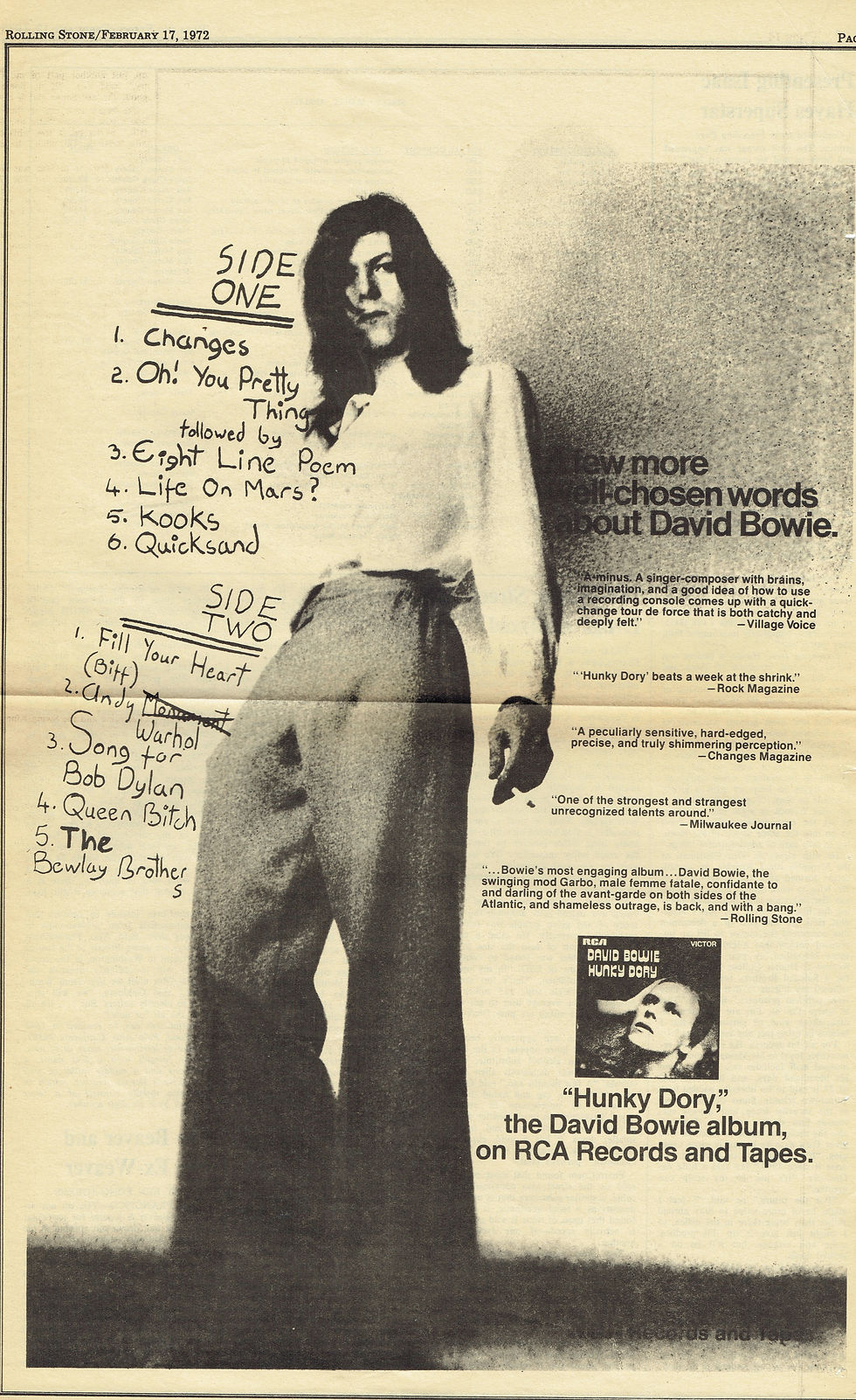
Possibly, just possibly, David Bowie could be the biggest thing to come out of Britain this year, and if this album is any indication, it won't be through hype either. "Hunky Dory" is not only the best album Bowie has ever done, it's also the most inventive piece of song-writing to have appeared on record for considerable time. His songs, although they adhere to a strictly pop format for the most part, have that sort of inner depth that is found in the work of Lou Reed, the songwriter with whom Bowie seems to share an affinity. Bowie, perhaps, recognises this. Queen Bitch" on this album is an exact parody of Velvet Underground style, right down to Lou Reed vocal and arrangement. Bowie's songs are not intellectual. Rather, they're a mirror held up to the events and circumstances that surround the singer. As such, their meaning is often shrouded in ambiguity. Can he be for real, for example, when he talks of his sexual aberrations in "Queen Bitch," whose theme is about some guy stealing his boyfriend? Or Kooks," where he sings to his son, Zowie, warning him that if he stays with his parents when he grows up he's "gonna be pretty kooky, too?" His own caricature as a priest of high camp, replete with flowing dress and Lauren Bacall/Greta Garbo hair, is reflected in his writing. He belongs to that oeuvre which Alice Cooper occupies; he's Mick Jagger's heir; and his songs as such carry outrage. This album is his best because it can be listened to at any level. Each of the songs is musically arresting (the only number he didn't write was Biff Rose's "Fill Your Heart"). Most of them are enormously catchy, like "Changes," with its stuttering chorus, descendant of "My Generation"; or "Oh! You Pretty Things," which has become one of the most infectious pop compositions of all time, so irresistible that it's a wrench to even take it off the turntable. Then you can take your pick from "Life On Mars?" with fabulous Ken Scott production like a movie soundtrack, a "Quicksand," with its gorgeously aching chorus and a dying vocal fall that recalls Joni Mitchell on "For Free," and "Andy Warhol," featuring mesmerising guitar from Mick Ronson. - M.W.
Do you have this Melody Maker review in your archive? Did Hunky Dory become the biggest thing? Share in the comments!


Comments