
The Cretaceous Period Cover: 1971
- T.Rex

- Dec 1, 1971
- 3 min read
Updated: Dec 16, 2025
T. REX

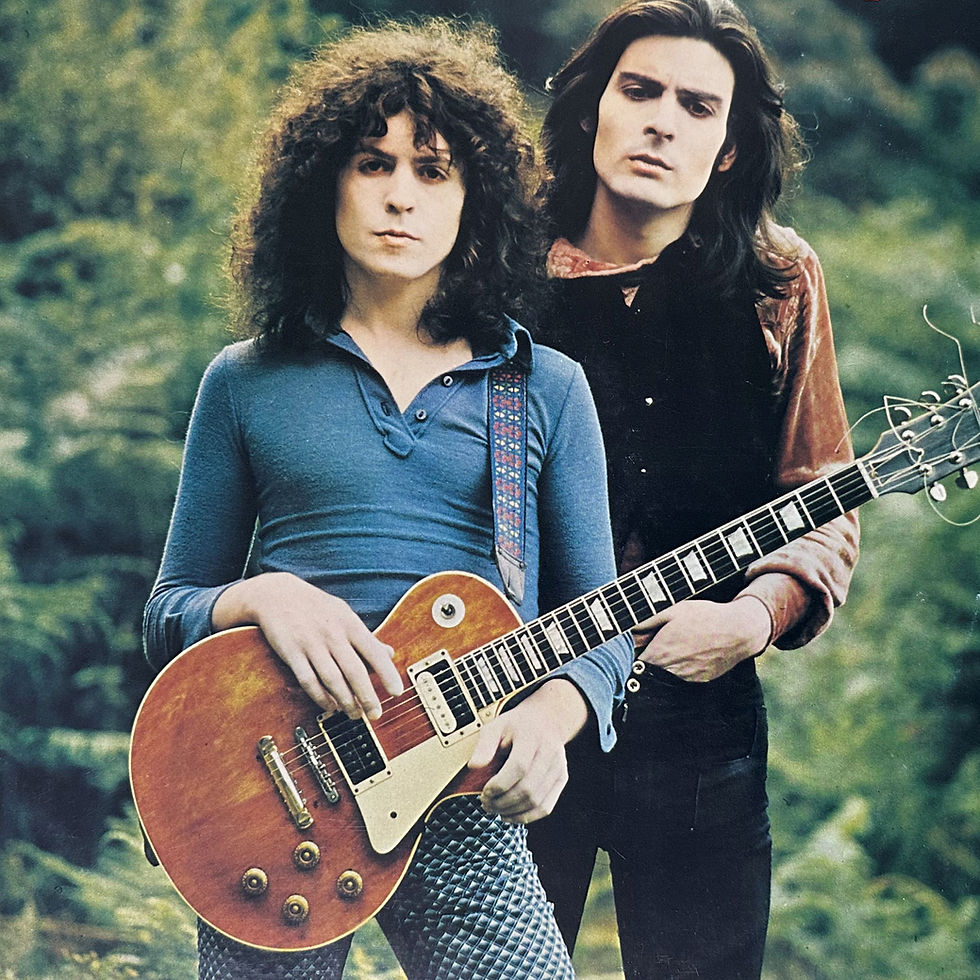
Strictly speaking, the story begins more than 65 million years ago. It was during the Cretaceous period that the over fourteen-meter-long dinosaur Tyrannosaurus ruled the Earth as the largest living creature. One thousand nine hundred and sixty-seven years after the Common Era, a certain Marc Bolan remembered this prehistoric creature and, together with Steve Peregrin Took, founded a small group with a mammoth name: Tyrannosaurus Rex.
Marc Bolan, born on July 30, 1947, in the London borough of Hackny, received a Gibson guitar as a gift from his father when he was nine years old. And Marc sat down and played the instrument, which was as old as he was. But Marc wasn't only interested in his guitar; he began writing poetry even then, and at fourteen he sat down to write his first book. It was supposed to be an autobiography, but Marc only got to page 102. He gave it up and "stood there like a stupid boy, without plans, without a goal," as he recalls today
Marc left school, hitchhiked to France, and joined a magician with whom he stayed for almost a year. In 1965, he returned to England, played bass guitar in a band, and tried his luck with demo tapes, which he used to audition for various record companies. Bolan's first single was 'The Wizard', the story of his meeting with the magician. Although only about two hundred copies of the
When his record found a buyer, Marc got an appearance on the English television show 'Ready Steady Go' through friends. But nothing came of it. It wasn't until 1967 that his second record, 'Hippy Gumbo', was released, and shortly afterwards he played lead guitar for John's Children—a job that was actually intended for Pete Townshend, who ultimately preferred to stay with The Who. Marc stayed with John's Children for three months, composed the song 'Desdemona', and then left. He met drummer Steve Took and founded Tyrannosaurus Rex.
Marc composed, wrote lyrics, sang, and played guitar. And since Steve particularly enjoyed playing bongos, hand drum, and the sitar, the duo's music was heavily influenced by Far Eastern stylistic elements.
Marc and Steve played in smaller clubs or even for free in Hyde Park, and despite several LPs, Tyrannosaurus Rex remained relatively unknown
At the end of 1969, after a less than overwhelming American tour, Steve had had enough and left: Marc had to find a new bandmate. But nobody wanted to step in. Marc almost sold his guitar when he met Mickey Finn just in time. Marc and Mickey hit it off immediately and after only a few days began practicing together in the solitude of the Welsh mountains. Mickey plays tabla, congas, bongos, finger cymbals, bass guitar, and Moroccan jaw harp, and once again this distinctive sound emerged, emphasizing the exotic rhythms of Far Eastern instruments and the melody primarily carried by Marc's exceptional vocals. Marc and Mickey played together for just under a year, and T. Rex, as the two now called themselves, achieved widespread recognition with the single 'Ride A White Swan'. 'Hot Love', the following T. Rex album,
It reached number 1 in the British Top Ten just two weeks after its release. Marc and Mickey had done it.
But Marc wasn't satisfied yet: the sound of T. Rex needed to be denser. Marc, who had already microscopically reduced the monstrous name of the small group Tyrannosaurus Rex, now envisioned an expanded lineup with the shortened name T. Rex: drummer Bill Fyfield and bassist Steve Currie were hired. And for the third time within a year, a T. Rex single reached the top of the British charts – <<Get It On> was the slogan.
Marc Bolan has been constantly taking on new projects. He wants to set the poems from his collection 'The Children Of Rarn' to music and release them on an LP. Marc in an interview with Pop: "Since I've always written poetry, I naturally place particular emphasis on the lyrics of a song-
des. But just as in poetry the expressiveness depends essentially on the pronunciation and emphasis of the words, in music great importance must be attached to the vocals and instrumental accompaniment as carriers of the text. Everyone knows that music can often express more than many words. And so rock music is increasingly developing into onomatopoeia, into an almost Dadaist soundscape.>> For 24-year-old Marc, music is a phenomenon: "It's very important to recognize," he says, "that music is a very important medium. Music relates to our whole lives, constantly comes into contact with them. I get up in the morning and put on music, move to music, make love to music. And if I go to the cinema and the film doesn't have good musical accompaniment, I don't like the whole film.">>>




Comments